
Sources for Previous Residents of a Laguna Beach Address
The previous residents of a Laguna Beach address appear in layers. Deeds identify recorded parties. City files date projects and applications. Telephone books and newspapers provide subscriber or social context. The federal census captures a household at fixed intervals. Probate and obituary records can explain the last appearance of a former owner or family. A good house history uses each source for the era and fact it can actually support.
| Source | Years It Covers | Where Held | What It Shows |
|---|---|---|---|
| Recorder index and books | Online structured index 1982-present; pre-1982 book/index route | RecorderWorks, Clerk-Recorder, Archives | Parties, types, dates, numbers; ordered image |
| City property and project files | Historic and modern; first permit year varies | OnBase and City Hall | Alterations, applications, dated roles, plans |
| Orange County directories | 1926, 1929, 1931 | NARA inventory | Alphabetic and possible street bridge |
| LOC telephone books | 1934-1960 in linked segments | Library of Congress | Subscriber, address, exchange, phone |
| Newspapers and census | Newspapers 1919-1989; census through 1950 public | OCPL, NARA, libraries | Social notices, obituaries, household snapshots |
| Historic inventory and maps | Pre-1940 resources; Sanborn years unconfirmed | City, Historical Society, LOC | Buildings, use, architecture, street context |
Start with the source closest to the fact you know. A modern address begins in GIS and OnBase. An ownership question begins in RecorderWorks. A 1930-era household begins with NARA, the census, and newspapers. A pre-1940 house can begin with the Historic Resources Inventory and the Historical Society's house-history route. The collection details are expanded on the city directory page, while the current address chain stays with the street directory.
Start a House History of Laguna Beach Previous Residents with GIS
The Historical Society's “Research Your House” guide is a local access map for previous residents and older parcels. Resolve the address in city GIS, check the pre-1940 Historic Resources Inventory, review city preservation files, ask the Library Local History Room, and move to Orange County Archives for older county records. The guide is useful because a modern parcel can lead to architectural and administrative sources before a surname search is attempted.
The city GIS address autocomplete can expose a parcel, APN, pop-up, local layer, and Property Information link. A small number of homes do not appear, so City Public Records Search is the fallback. The Historic Resources Inventory highlights older resources, including examples at 412 Glenneyre Street from 1897, 422 Glenneyre from 1908, and 359 Third Street from 1914. Those dates are source-selection clues, not proof of who lived there.
The Historical Society house-history guide lays out the local research sequence.
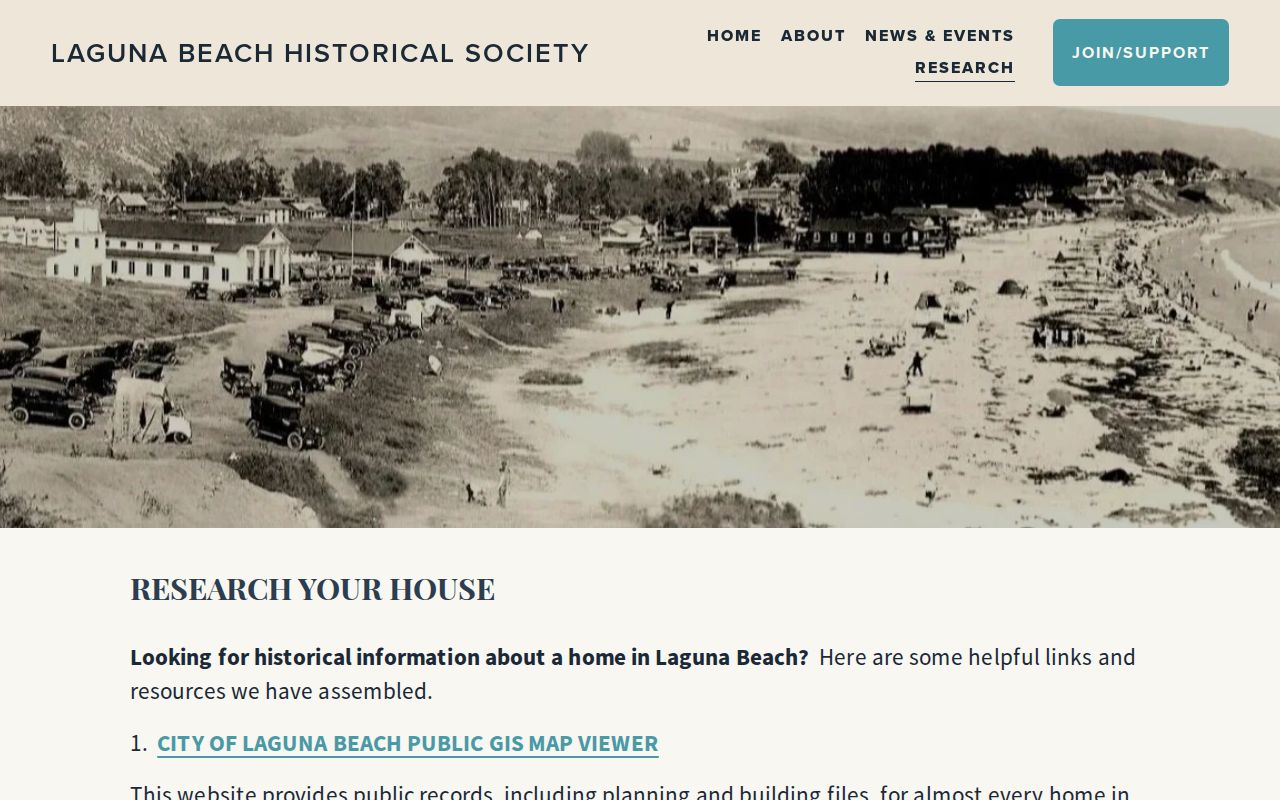
The guide connects GIS, historic inventory, preservation files, library material, and archives into one address trail.
Bridge the 1982 Laguna Beach Previous Residents Recorder Cutover
RecorderWorks provides structured Grantor/Grantee coverage from 1982-present. A 1982-forward instrument uses the recording year plus a six-digit number. Earlier documents use book and page, with an instrument number when available, and the portal's Index Books, Display Index, and Fiche Cell path may be needed. The imaging cutover for complete deed images is not stated, so do not assume that every older reference is online.
Search the current grantor or grantee only after the parcel, legal description, and date are anchored. When a result supplies an instrument number, order the copy from the Clerk-Recorder. If the online index cannot reach the desired period, use the counter, Orange County Archives, deed books, indexes, and fiche. Staff do not perform a name search for a caller or mail customer.
The recorded-document source is the legal bridge between a present parcel and an earlier title instrument.
Walk the Laguna Beach Previous Residents Deed Chain Backward
A chain of title is the sequence of recorded transfers that connects a parcel to earlier parties. Start with today's APN and legal description, not an assumed owner name. The county Assessor's web tool does not display the owner, so use a RecorderWorks conveyance, the counter, an authorized parcel source, or a city file that legitimately names a dated owner or applicant.
- Resolve the current address to APN and legal description in GIS.
- Identify the current acquisition instrument through RecorderWorks, the Clerk-Recorder, or counter evidence.
- Read the deed's grantor, grantee, vesting, recording date, and legal description.
- Search the prior grantor as an earlier grantee, constrained by the same legal description and a plausible date.
- Repeat backward, then move to book, page, fiche, deed books, or Archives for pre-1982 material.
- Grantor
- The party transferring an interest in the recorded instrument.
- Grantee
- The party receiving the recorded interest.
- Chain of title
- A linked sequence of recorded conveyances for one parcel.
- Legal description
- The lot, block, tract, or metes-and-bounds text that identifies land when a street label changes.
Never chain on an identical name alone. Trusts, entities, common surnames, and changed mailing addresses make the legal description and date essential.
Property Files Date Changes, Not Occupancy
OnBase and the public permit portal can show when a building, planning, inspection, or project event reached City Hall. A permit application may contain project address, description, classification, valuation, applicant, owner, contractor, DBA, license, and design professional. Those fields are valuable for a house history because they place a name at a date and explain an alteration.
They do not prove that the applicant lived at the address. Plans are public for inspection, but copyright controls copying. The city describes a plan-duplication request, affidavit, certified authorization to current or original owners and registered professionals, a 30-day response window, and a flash-drive release for approved copies. Keep the project role separate from household evidence.
Laguna Beach's city records instructions show the dated project layer behind an address history.
Use Historic Inventory for Pre-1940 Homes
The Historic Resources Inventory is a useful bridge for older Laguna Beach properties. Its neighborhood index and PDFs can provide build date, architectural history, and earlier source citations. Examples identified by the city include 412 Glenneyre Street from 1897, 422 Glenneyre from 1908, and 359 Third Street from 1914, with other Forest Avenue and Coast Highway resources from the 1920s and 1930s.
Use the inventory before a broad surname search. An architectural record can show that a current address existed in an earlier form, while the library and newspaper collections can supply the names. Library of Congress Sanborn maps may add footprint, construction, material, and use context, but exact Laguna sheet years were not confirmed in the inspected collection. Do not treat a map footprint as an occupant record.
Note: The city is reviewing 54 Historic Register properties without recorded Preservation Agreements, creating a current verification trail among inventory, permits, packets, and recorded instruments.
Pair Laguna Beach Previous Residents Directories with Public Census
Household history needs more than the seller-to-buyer chain. NARA's 1926, 1929, and 1931 Orange County directory references can frame the years around incorporation. LOC telephone books continue from 1934 to 1960. OCPL newspapers run from 1919 to 1989. The public census schedules for 1930, 1940, and 1950 supply fixed household snapshots, while the 72-year rule means 1950 remains the latest public population census in 2026.
Compare the address, surname, spouse, occupation, and neighboring entries. Census enumeration districts and boundary changes can shift the apparent location. A family may be present in a newspaper but absent in a telephone book. A directory entry may show only one subscriber. Record the source and issue rather than smoothing the gaps into a continuous story.
Close a Laguna Beach Previous Residents Trail with Probate
Probate and obituary records can explain why a deed moves to heirs, a trust, or an entity. They can also close a previous-residents trail when a former owner died after leaving Laguna Beach. Search the former owner's name in the Orange County probate path, then compare petitions, notices, and public party roles with the deed's legal description. An obituary can add relatives, a former street, an organization, and a death date. It is a clue supplied by family or publisher, not a substitute for a vital certificate.
County Clerk-Recorder vital-record channels offer authorized and informational copies. Historical indexes, newspapers, cemetery sources, and the Historical Society can bridge a date when a modern copy is restricted. This is often the point where previous residents become a family-history question rather than a title question.
Separate property and vital custodians help keep a former owner's title trail distinct from a family event record.
Order a Laguna Beach Death or Marriage Record
The end of a previous-resident trail may involve a death, marriage, or birth record. Orange County issues certificates for county events through in-person, mail, and online channels. Authorized copies require eligibility and identity steps. Informational copies are broader but cannot establish identity. Mail forms require signatures and notarization, and a failed search still uses the fee.
The 2025 schedule lists $24 for an Orange County death copy and $32 for a birth copy. Marriage charges need a current check. Before ordering, write down the exact name, event date and place, parent or spouse detail, and the relationship or statutory purpose. A newspaper or probate clue can make the official application precise without exposing a protected record.
The application channel determines what a copy can legally establish.
Laguna Beach Previous Residents: Directories, Census, and Obituaries
Owners are only half of a previous-residents search. Telephone books and criss-cross directories can show the listed subscriber or primary householder. The public census can show a household at a fixed date. Newspapers can fill a move, death, marriage, sale, or community connection. Pair each directory decade with the closest census year, then use the Laguna Beach city directory page for the collection details.
Household evidence still has omissions. A line may be unlisted. A name may use an initial or married surname. A street may carry a different suffix or municipal heading. A disappearance can mean death, move, publication omission, or changed boundary. Preserve the gap and test it with a second source.
Lawful use. Previous-resident research in Laguna Beach is for house history, family history, estate work, and careful personal curiosity. Do not use a name or address to harass, track, intimidate, or harm a living person. Verify sensitive facts with the custodian.